
If you have ever passed a long truck stacked with cars on the highway, you have seen a car hauler, also called a car carrier or auto transporter. These trucks move most of the new and used vehicles in the United States, from factory-fresh cars heading to dealerships to family cars going across the country. This guide explains the main types of car haulers, how they work, what a hotshot truck is, how each type affects the price and safety of your shipment, and how to choose the right one for your vehicle.
NIKI Auto Transport matches every shipment with the right type of licensed carrier for the route and the vehicle. If you are ready to ship, request a free quote on our car shipping quote page.
In this guide
- What is a car hauler?
- Types of car haulers
- Open car carriers
- Enclosed car carriers
- What is a hotshot truck?
- Flatbeds, tow trucks and single-car haulers
- Comparison table
- How cars are loaded and secured
- Size, weight and driver rules
- Which car hauler is right for your vehicle?
- How to hire a car hauler
- FAQ
What is a car hauler?
A car hauler is a truck and trailer designed to transport vehicles. The term covers everything from a pickup truck towing a single-car trailer to a full-size tractor-trailer carrying nine or ten cars. Car haulers are operated by auto transport carriers, which can be large fleets or individual owner-operators.
People also use several other names for the same equipment:
- Car carrier or car carrier truck
- Auto transporter or auto transport trailer
- Car haulage (more common in British English)
- Car trailer or car hauler trailer
The type of hauler used for your car affects how much you pay, how quickly your car is picked up and how protected it is on the road.
The main types of car haulers
Most vehicles in the U.S. move on one of these:
- Open multi-car carriers, which carry seven to ten vehicles on two open decks
- Enclosed carriers, which protect vehicles inside a covered trailer
- Hotshot trucks, usually a heavy-duty pickup with a two- to four-car trailer
- Flatbeds and wheel-lift tow trucks, for short local moves and non-running vehicles
Open car carriers
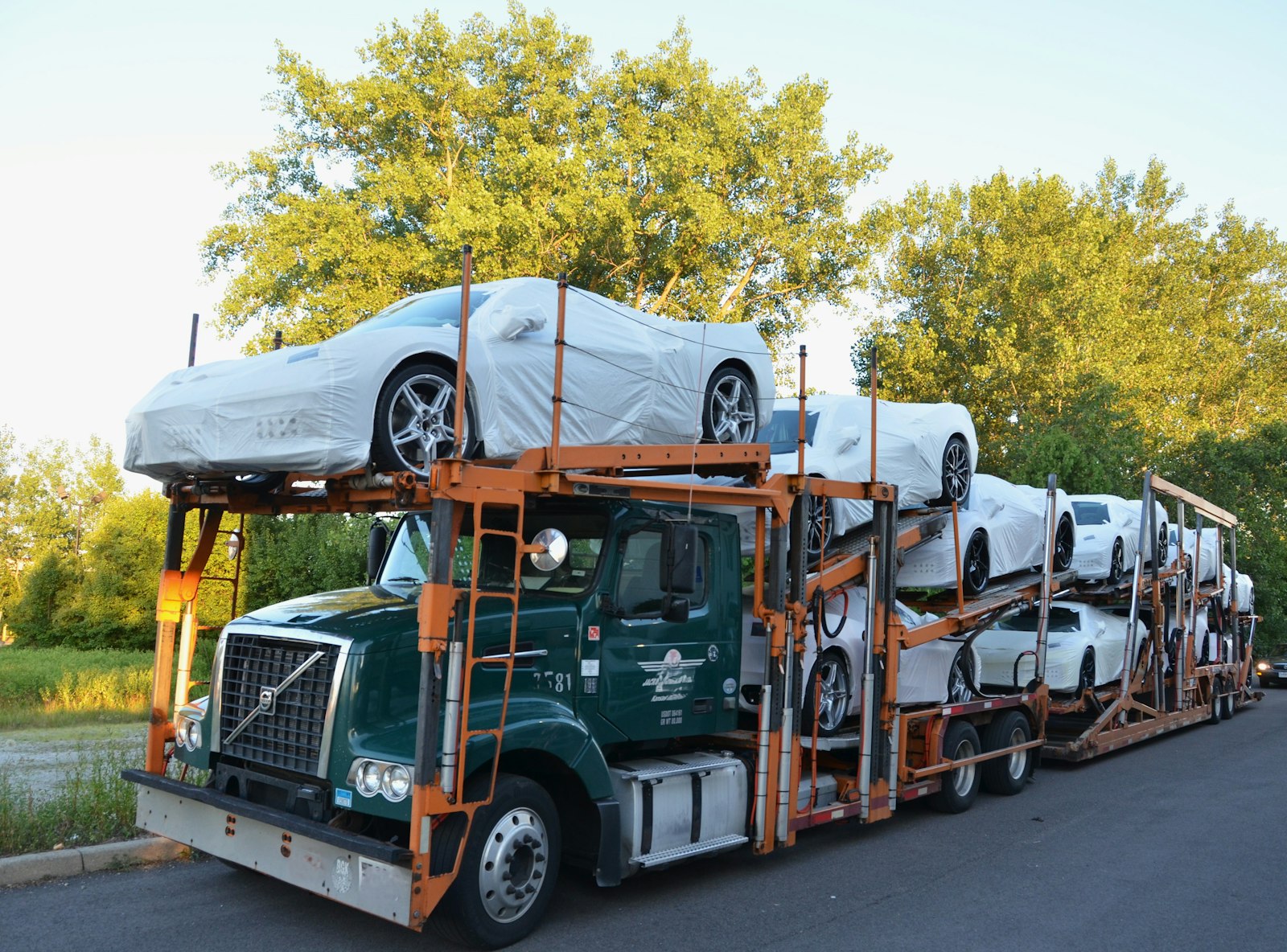
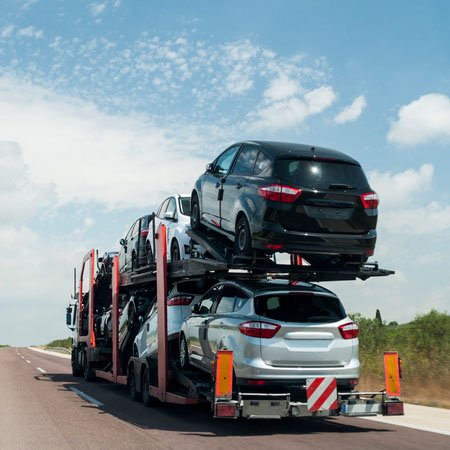
Open car carriers are the most common car haulers on the road. They are long tractor-trailers with two levels of ramps and no walls or roof. A typical full-size open carrier can carry seven to ten standard vehicles, depending on their size and weight.
Common open carrier designs
- Stinger steer: The trailer hitch sits low behind the rear axle, which lets the truck carry a car over its cab. This design is common for new vehicle deliveries from factories and ports.
- High-mount (high-rail): The trailer connects on a standard fifth wheel. Many long-haul carriers that serve the consumer market use this setup.
- Wedge trailers: Smaller, single-level trailers shaped like a wedge, usually carrying three or four cars behind a pickup or a smaller truck.
Advantages of open carriers
- Lowest cost, because the carrier spreads its costs across many vehicles
- Most availability, so pickup is usually faster
- Good for most vehicles, including everyday cars, SUVs and pickups
Disadvantages
- Your car is exposed to weather, dust and small road debris, much as it would be if you drove it
- Very low cars may have trouble with the ramps
Learn more on our open car transport page.
Enclosed car carriers
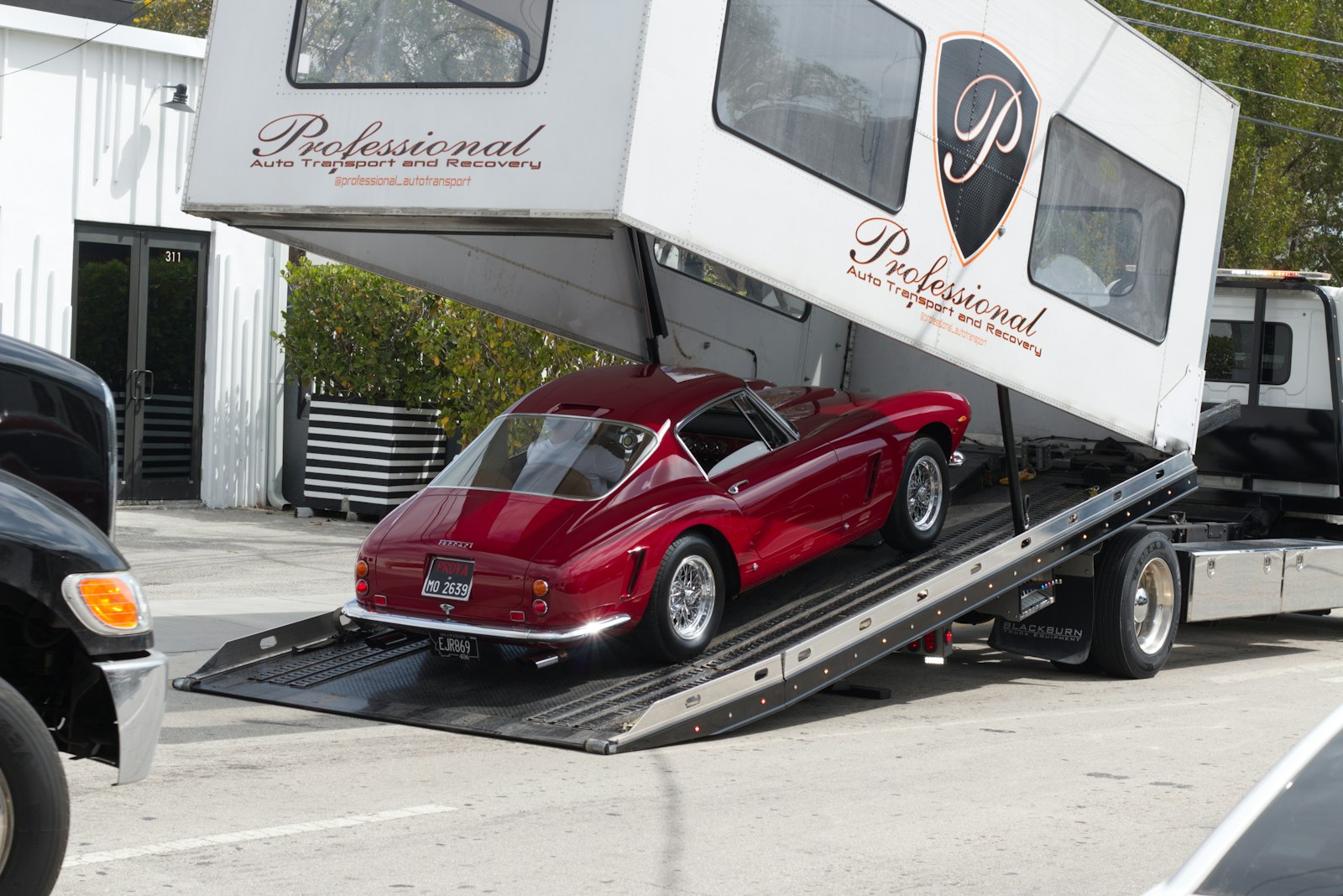
Enclosed car carriers carry vehicles inside a fully covered trailer, protecting them from weather, rock chips and prying eyes. Enclosed trailers range from single-car trailers towed by a pickup to full-size tractor-trailers that carry six or seven cars.
Features often found on enclosed carriers
- Hydraulic liftgates, which lift the car level instead of driving it up a steep ramp, important for low sports cars
- Soft tie-downs that secure the wheels rather than the frame or suspension
- Higher cargo insurance limits, often chosen for high-value vehicles
- Climate protection from rain, snow, sun and salt
Who uses enclosed carriers?
- Owners of classic, vintage and collector cars
- Luxury and exotic car owners
- Car show and auction participants
- Anyone shipping a newly restored or freshly painted vehicle
Enclosed transport usually costs about 30% to 60% more than open transport on the same route. See our enclosed car transport page and our comparison of open vs. enclosed auto transport.
What is a hotshot truck?
“What is a hot shot” is one of the most common questions about car hauling. A hotshot is a smaller, faster setup: usually a heavy-duty pickup truck, often a one-ton dually, pulling a gooseneck or wedge trailer that holds two to four vehicles.
Why hotshot trucks are used
- Speed: With fewer cars to pick up and deliver, a hotshot can often move a vehicle faster than a large carrier making many stops.
- Access: Smaller rigs can reach narrow streets, tight neighborhoods and rural roads that a 75-foot tractor-trailer cannot.
- Flexibility: Hotshots are often used for short regional routes, dealer trades, auction pickups and expedited jobs.
Trade-offs
- The cost per vehicle can be higher than on a full-size carrier on long routes.
- Capacity is limited, so availability depends on the area.
Hotshot carriers still need proper federal operating authority and insurance when they haul vehicles for hire across state lines, depending on their size and weight. Always check the carrier’s USDOT number.
Flatbeds, tow trucks and single-car haulers
Flatbed (rollback) tow trucks
A flatbed tow truck has a bed that tilts and slides back to the ground. The car is winched onto the bed. Flatbeds are common for local moves, breakdowns and non-running vehicles, and are sometimes used for the first or last mile of a long-distance shipment.
Wheel-lift and dolly tows
These lift one end of the car off the ground. They are fine for short tows but not used for long-distance transport.
Single-car trailers
Open or enclosed single-car trailers pulled by a pickup are often used for dedicated, door-to-door moves of a special vehicle, such as a race car or a classic headed to a show.
Car hauler comparison table
| Type | Typical capacity | Protection | Relative cost | Best for |
|---|---|---|---|---|
| Open multi-car carrier | 7–10 vehicles | Open to weather | Lowest | Most cars, SUVs and pickups on long routes |
| Enclosed multi-car carrier | Up to about 7 vehicles | Fully covered | Higher | Luxury, classic, exotic and collector cars |
| Hotshot (pickup + trailer) | 2–4 vehicles | Usually open | Varies | Short routes, tight access, expedited moves |
| Single-car enclosed trailer | 1 vehicle | Fully covered | Highest | Dedicated moves of very high-value vehicles |
| Flatbed tow truck | 1 vehicle | Open | Varies | Local moves and non-running vehicles |
How cars are loaded and secured on a car hauler
Loading a car carrier is a skill. Drivers plan the order of loading around the delivery stops, the weight of each vehicle and the height limits of the load.
- Pickup inspection: The driver walks around the car with you and records its condition on the bill of lading.
- Load planning: Heavier vehicles usually go on the lower deck and over the axles. Vehicles delivered first are often loaded last.
- Driving on: Running cars are driven up the ramps. Non-running cars are pulled up with a winch.
- Securing: Cars are secured with wheel straps, chains or a combination, depending on the carrier and the vehicle. Many carriers prefer soft straps over the tires to avoid stressing the suspension.
- Checks during the trip: Drivers check tie-downs regularly, especially after the first miles and after rough roads.
- Delivery inspection: At delivery, you inspect the car again and sign the bill of lading.
How the type of car hauler affects your price
The car hauler assigned to your shipment is one of the biggest factors in what you pay.
- Open multi-car carriers spread fuel, insurance and driver costs across seven to ten vehicles, so each customer pays less. This is why open transport is the most affordable option.
- Enclosed carriers carry fewer vehicles, use more expensive equipment and carry higher insurance limits, so each vehicle costs more to ship.
- Hotshots can be cost-effective for short routes or hard-to-reach addresses, but on long routes the cost per vehicle is often higher because the truck carries fewer cars.
- Dedicated single-car transport is the most expensive, because one customer pays for the whole trip.
Your vehicle also affects which hauler can take it. A large pickup or SUV takes up more space and weight on a carrier than a compact sedan, and a lifted truck may only fit on the lower deck. A vehicle that does not run requires a hauler with a winch. Learn more in our car shipping cost guide.
Car hauler capacity changes with the seasons
Car haulers follow demand. In summer, when many families move, and during snowbird season, when retirees head to Florida, Arizona and Texas in the fall and back north in the spring, trucks fill quickly on popular routes. During those peaks, booking two to six weeks ahead helps you get a spot on a carrier at a fair price. In quieter months, carriers have more open space, and pickups can be faster. Winter storms in the Northeast and Midwest can also slow haulers for a few days at a time.
Car hauler terms you may hear
- Bill of lading (BOL): The inspection and shipping document you sign at pickup and delivery.
- Deck: A level of the trailer. Most open carriers have an upper and a lower deck.
- Headrack: The space over the truck cab where some carriers load a vehicle.
- Stinger: A carrier design where the trailer hitch sits behind the rear axle of the truck.
- Gooseneck: A trailer hitch that connects in the bed of a pickup, common on hotshots.
- Dually: A pickup with dual rear wheels, often used to pull hotshot trailers.
- Liftgate: A hydraulic platform that lifts a vehicle onto an enclosed trailer.
- Winch: A motorized cable used to pull non-running vehicles onto a trailer.
- Soft ties: Fabric straps that secure a vehicle by its wheels.
- Pickup window: The range of days during which the carrier will pick up your vehicle.
What happens while your car is on the hauler
Once your car is loaded, the driver follows a route planned around every pickup and delivery on the load. Long-haul drivers typically cover several hundred miles a day, within federal driving-hour limits, and stop for rest breaks, fuel and inspections. Your car may be moved between decks if the load needs to be rearranged for a delivery. Most carriers can give an estimated arrival time, and the driver calls ahead before delivery. Your transport company should be able to give you updates if you have questions while the car is on the road.
Car hauler size, weight and driver rules
Car haulers must follow federal and state rules on length, height, weight and driving hours.
- Length: A full tractor-trailer car carrier can be roughly 70 to 80 feet long. That is why drivers sometimes ask to meet at a nearby wide street or parking lot instead of your driveway.
- Height: Loaded carriers must clear bridges and overpasses, which limits how tall vehicles on the top deck can be.
- Weight: Federal weight limits restrict how many heavy trucks and SUVs fit on one load.
- Licensing: Drivers of larger combinations need a commercial driver’s license, and interstate for-hire carriers need FMCSA authority and insurance.
- Hours of service: Drivers are limited in how many hours they can drive each day, which is one reason transit times are given as ranges.
Which car hauler is right for your vehicle?
| Your situation | Recommended hauler |
|---|---|
| Everyday car, SUV or pickup, any distance | Open multi-car carrier |
| Classic, exotic, luxury or freshly restored car | Enclosed carrier, ideally with a liftgate |
| Very low ground clearance | Enclosed carrier with a liftgate or low-angle ramps |
| Non-running vehicle | Any carrier with a winch, or a flatbed for short moves |
| Tight urban or rural access, short regional route | Hotshot truck |
| Lifted truck or oversized vehicle | Carrier with suitable deck height, sometimes a hotshot or flatbed |
| Motorcycle | Carrier with motorcycle equipment; see motorcycle shipping |
| Hawaii | Truck to a West Coast port, then an ocean vessel; see Hawaii car shipping |
How to prepare your car for a car hauler
- Wash the car so the driver can record existing scratches and dents accurately.
- Photograph every side, the roof, the wheels, the interior and the odometer, with dates.
- Remove personal items, toll transponders, parking passes and garage openers.
- Leave about a quarter tank of fuel. That is enough for loading without adding unnecessary weight.
- Check the battery, tires and brakes, so the car can be driven on and off the trailer safely.
- Fix or report leaks. Carriers may refuse a vehicle that leaks fluids onto cars below it.
- Fold in mirrors and remove loose parts, such as antennas, bike racks and spoilers that could come loose.
- Disable the alarm, or give the driver instructions for turning it off.
- Tell the company about modifications such as lift kits, lowered suspension or oversized tires.
Car hauler safety: what protects your vehicle
Professional car haulers move millions of vehicles a year, and most arrive without any problems. Several things protect your car:
- Trained drivers who load, secure and check vehicles every day
- Federal safety rules on driver hours, vehicle inspections and drug and alcohol testing for commercial drivers
- Cargo insurance that covers vehicles on the carrier’s truck
- The bill of lading, which records your car’s condition at pickup and delivery
- Load planning, which places heavier vehicles low and spreads weight across the trailer
The most important thing you can do is document the car carefully at pickup and inspect it at delivery before you sign.
Car haulers for special vehicles
- Motorcycles: Carriers use wheel chocks and soft straps, or crates for long routes. See motorcycle shipping.
- Classic and exotic cars: Enclosed trailers with liftgates and soft tie-downs. See classic car shipping and luxury and exotic car shipping.
- Trucks and large SUVs: Heavy vehicles usually ride on the lower deck. See truck shipping services.
- Electric vehicles: EVs are heavy, so carriers plan weight carefully. Ship with a partial charge, usually 30% to 50%.
How to hire a car hauler
You have two main options:
- Book through a licensed auto transport broker, which finds a carrier with the right equipment on your route and manages the shipment.
- Book directly with a carrier, if you find one that runs your exact route on your dates.
Most people choose a broker because it gives access to thousands of carriers and backup options if a truck is delayed. Our guide to auto transport brokers vs. carriers explains the difference, and our guide on how to choose a car shipping company walks through the checks to make.
Before you hire any car hauler
- Verify the USDOT and MC numbers on FMCSA’s SAFER system.
- Ask for the certificate of insurance and the cargo coverage limit.
- Get the price, pickup window and payment terms in writing.
- Tell the company about any modifications, low clearance or mechanical problems.
- Remove personal items and leave about a quarter tank of fuel.
Looking to haul cars yourself?
Many people searching for car haulers are drivers interested in the business. Running a for-hire car hauling operation across state lines requires a USDOT number, operating authority, insurance and, for larger rigs, a commercial driver’s license. If you already run a licensed car carrier and want loads, visit our carrier relations page.
Ship your car with the right car hauler
NIKI Auto Transport is a licensed and bonded auto transport broker (USDOT 4535689, MC-1799148). We match your vehicle with the right type of car hauler, open, enclosed or hotshot, from a network of vetted, insured carriers, and we back your booked price with NIKI’s Price Guarantee. We arrange door-to-door car shipping nationwide, including cross-country moves.
Get a free written quote on our car shipping quote page, or call (818) 732-1805.
Quick summary
- Open car carriers move most vehicles and are the most affordable choice.
- Enclosed carriers protect classic, luxury and exotic cars and cost more.
- Hotshot trucks are smaller rigs for short routes, tight access and urgent jobs.
- Flatbeds and tow trucks handle short local moves and non-running vehicles.
- Whatever the hauler, check the carrier’s USDOT number and insurance, get your price in writing, and inspect the car carefully at pickup and delivery.
Still deciding how to move your vehicle? The guides below explain how to pick a trustworthy company, how brokers and carriers work together, and what to expect on delivery day, so you can book the right car hauler with confidence.
Related car shipping guides
- How to choose a car shipping company: 12 checks and red flags before you book
- Auto transport broker vs. carrier: who arranges your shipment and who moves it
- Open vs. enclosed auto transport: which protection level fits your car
- Should you tip your car transport driver?: delivery-day etiquette for drivers and tow operators
Frequently asked questions
What is a car hauler?
A car hauler is a truck and trailer built to transport vehicles. Types include open multi-car carriers, enclosed carriers, hotshot trucks and flatbed tow trucks.
How many cars can a car hauler carry?
A full-size open car carrier typically carries seven to ten vehicles. Enclosed tractor-trailers carry up to about seven, hotshot trucks two to four, and flatbeds one.
What is a hotshot truck in car shipping?
A hotshot is usually a heavy-duty pickup pulling a trailer that holds two to four vehicles. Hotshots are used for short routes, tight access and expedited moves.
Is open or enclosed car hauling better?
Open hauling is cheaper and faster to schedule and works well for most vehicles. Enclosed hauling costs more and protects classic, luxury and exotic cars from weather and road debris.
How are cars secured on a car carrier?
Cars are secured with wheel straps, chains or both, depending on the vehicle and carrier. Drivers check the tie-downs regularly during the trip.
How do I hire a car hauler?
You can book through a licensed broker, which finds a carrier on your route, or directly with a carrier that runs your route. Always verify USDOT and MC numbers, insurance and written pricing first.