
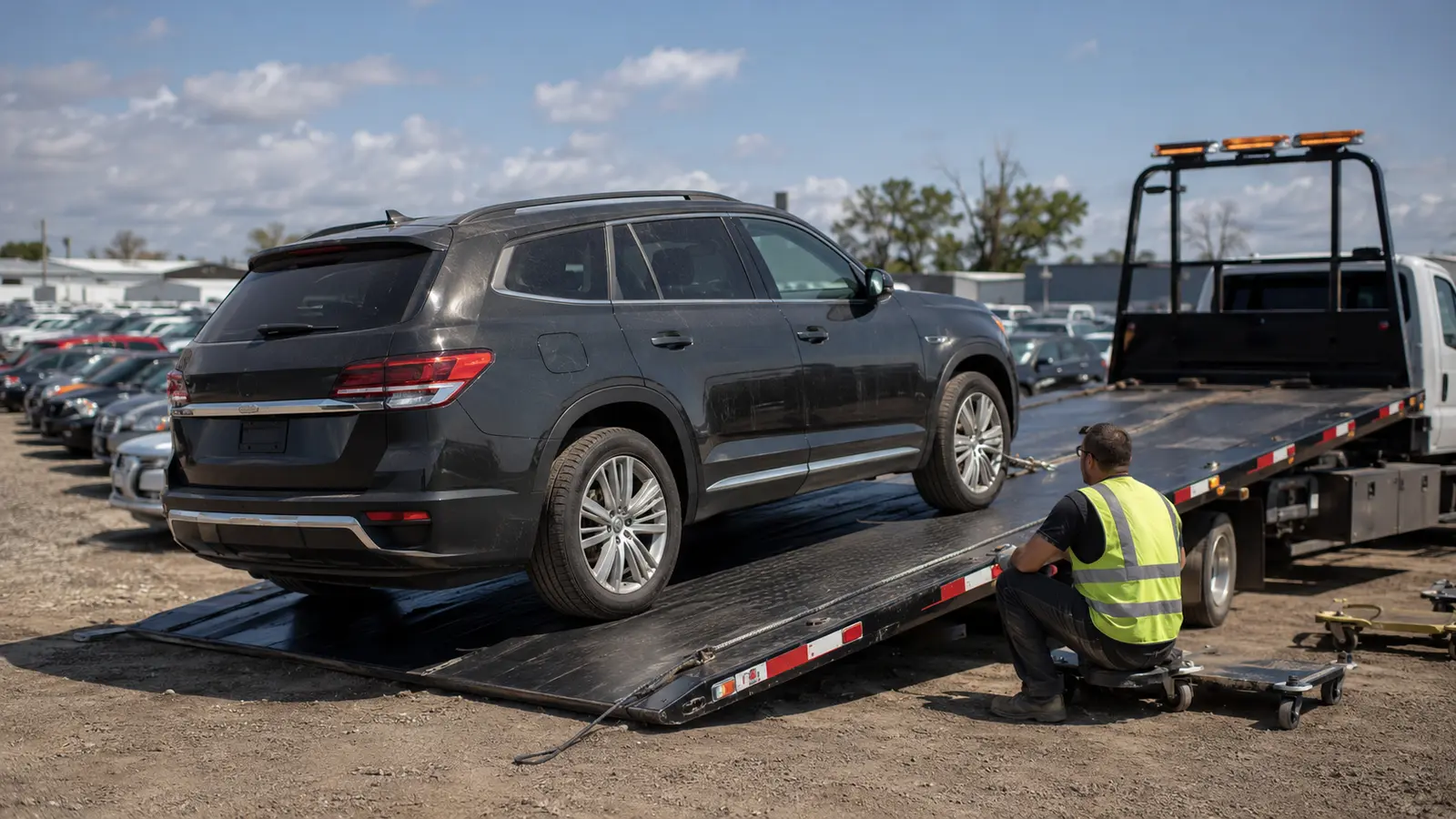
Coordinate payment, transporter assignment, gate credentials, appointments, storage deadlines and the right equipment for Copart and IAA purchases.
Read customer reviews on Facebook →Copart and IAA make it possible to buy vehicles from yards across the country, but the winning bidder still has to remove the unit under the platform and branch rules. The vehicle may be operable, inoperable, collision-damaged, missing keys or unable to roll. The branch may use appointments, digital transporter assignment, a pickup PIN, a mobile app, a virtual queue or other controlled gate process. A carrier needs the correct authorization before it spends time reaching the lot.
This guide is platform-specific because Copart and IAA procedures are not interchangeable. Copart’s official buyer guidance describes assigning a third-party transporter and sharing the necessary gate credential; its payment and pickup guidance warns buyers to act promptly to avoid storage. IAA uses its own transportation options and Pickup PIN process. Features and deadlines can change, so the current account screen, branch instructions and official help pages remain the final authority.
NIKI Auto Transport is not Copart, IAA or a salvage yard. NIKI is an auto transport broker that can arrange physical transportation with an independently operated motor carrier. The buyer controls the auction account, payment, title and release authorization. The assigned carrier handles pickup, loading and delivery when the unit and branch match the order.
A careful buyer also separates transportation from ownership and repair. Shipping the unit does not confirm that a title is transferable, that damage is economical to fix or that the vehicle will pass an inspection in the destination state. Resolve licensing, title and repair questions with the appropriate auction, agency and qualified professional while the transport file focuses on safe release, loading, custody and delivery.
What to do immediately after winning
The buyer should move through payment, release, condition review and transport planning in parallel. Waiting for a storage warning before checking the vehicle’s loading needs can make the only available solution expensive.
Confirm the full balance and release status
Pay using an accepted method within the platform’s deadline and include required fees. Then check that funds have cleared and the specific lot shows eligible for pickup. A screenshot of a submitted payment is not the same as branch release. Holds, missing documents or account restrictions can still block the gate.
Record the VIN, lot or stock number, exact branch, buyer or member number, sale date and the last free pickup day. Keep receipts and release notices. If the account lists several purchases, make sure the credential belongs to the correct unit.
- Correct branch
- VIN and lot/stock number
- Payment cleared
- All fees satisfied
- Release eligibility
- Last free storage day
Review condition and loading before dispatch
Read the listing and condition information, but treat it as a starting point. Determine whether keys are present and whether the vehicle starts, rolls, steers and brakes. Look for missing wheels, broken suspension, loose panels, low clearance, heavy collision damage, fire or flood evidence and high-voltage battery concerns.
Send listing images and any updated branch information to the broker. A unit described merely as “inoperable” can range from a dead battery to a car with locked wheels. The transport method and destination unloading plan depend on the difference.
Copart third-party transporter workflow
Copart’s official process lets a buyer identify a third-party transporter through the account. The transporter then uses the current gate and pickup procedure, which may include a PIN, appointment or app-based check-in. The buyer should not publish or casually forward credentials.
Assign the transporter correctly
Use Copart’s current “Send to Transporter” or equivalent account function for the purchased lot. Enter the correct transporter information and share the gate credential only with the authorized pickup party. Confirm the branch and lot are visible to that transporter before travel.
The motor carrier’s legal name may differ from the broker’s brand because the broker arranges the load and the assigned carrier enters the yard. Ask NIKI for the assigned carrier information and use the legal carrier identity required by the Copart workflow.
- Select the exact lot
- Use the current Send to Transporter workflow
- Enter the assigned carrier accurately
- Protect the Gate PIN or credential
- Confirm before the driver travels
Pickup timing and yard loading
Copart tells buyers to pay for and collect vehicles promptly; its public guidance notes a short window before storage can accrue. The buyer should verify the exact branch calendar, fee schedule and sale terms because weekends, holidays and buyer type can matter. Treat the account deadline as controlling.
Copart yards may load many passenger vehicles, but loading policy varies by lot class and condition. Copart recommends suitable transport equipment and notes that medium- and heavy-duty units can require self-loading. Confirm the branch’s present rule and do not assume forklift service solves destination unloading.
| Copart checkpoint | Buyer action | Carrier action |
|---|---|---|
| Payment | Clear balance and fees | Wait for release |
| Transporter assignment | Send lot to authorized transporter | Confirm credential |
| Appointment/check-in | Provide current instructions | Follow app, PIN or queue process |
| Loading | Disclose condition and branch rule | Bring suitable equipment |
IAA transporter and Pickup PIN workflow
IAA provides its own transportation services and also supports buyer-arranged vehicle pickup. Its Pickup PIN system is designed to authorize the specific release. The buyer should follow the current IAA help instructions and send the PIN only to the driver or transporter collecting that stock.
Generate and share the correct IAA Pickup PIN
Confirm the vehicle is paid and ready, then obtain the PIN through the current IAA account process. Match the stock and branch. Send the PIN to the assigned carrier using a secure channel and verify the carrier’s legal name. An expired, incorrect or unassigned credential can cause a failed attempt.
Do not reuse credentials or post them in public messages. If the carrier changes, update the authorization according to IAA’s process rather than simply forwarding old information. Confirm branch hours and whether an appointment is required.
- Paid and eligible stock
- Correct branch
- Current Pickup PIN
- Authorized carrier identity
- Hours and appointment confirmed
IAA Transport versus buyer-arranged transport
IAA offers an in-platform delivery option for eligible purchases and locations. A buyer can compare that option with an independently arranged carrier based on destination coverage, equipment, timing and price. Read the terms because IAA is not the physical transporter in every arrangement and third parties may perform delivery.
Avoid placing duplicate transport orders for the same vehicle. If you select an IAA option and later use NIKI, cancel or clarify the first arrangement according to its terms. Duplicate dispatch can create gate confusion and fees.
Choose equipment for the actual salvage vehicle
The greatest risk in Copart and IAA shipping is equipment mismatch. A standard open carrier can move many operable vehicles. Salvage units with locked wheels, suspension damage, leaks or loose parts may need a winch, flatbed, wheel dollies or specialized recovery.
Ask six operability questions
Does it start? Does it move under its own power? Does it roll freely? Does it steer? Do the brakes work? Are all wheels and tires present? The answers are more useful than a single “run and drive” or “stationary” label. Add key status, ground clearance and visible structural damage.
A vehicle can start yet be impossible to load because a wheel is folded under it. Another may not start but roll easily onto a winch-equipped trailer. Provide photos that show wheel angles, underbody clearance, loose bumpers and the path around the unit.
- Starts?
- Moves?
- Rolls?
- Steers?
- Brakes?
- All wheels present?
Plan unloading before pickup
A branch forklift can place a non-rolling car on a trailer, but a suburban driveway probably has no forklift. Choose a body shop, dealer, yard or recovery company that can remove and move the unit. Confirm permission, hours, surface and truck access.
Hazardous or unstable vehicles may not be safe for standard transport. Disclose fuel leaks, damaged high-voltage batteries, burned areas, unsecured glass and sharp or hanging parts. The carrier can require stabilization or decline the load.
| Observed condition | Potential method | Destination need |
|---|---|---|
| Operable passenger vehicle | Open or enclosed carrier | Normal legal unloading point |
| Non-runner that rolls and steers | Winch-capable auto carrier | Flat space and keys/steering access |
| Locked or missing wheel | Flatbed, dollies or special trailer | Recovery equipment |
| Severe collision or battery damage | Case-specific specialist | Qualified repair or salvage facility |
Storage deadlines and branch timing
Storage is controlled by the marketplace and branch. Copart and IAA publish account terms and location information, but the buyer should verify the deadline for the specific sale. An auto transport estimate does not pause auction fees.
Book early but release before dispatch
Request a planning quote while bidding so you understand route and equipment. After winning, pay promptly, determine condition and activate transport. Do not wait until the final free day. At the same time, do not send a truck until the account shows released and transporter authorization is complete.
Specialized units and rural branches may need longer to match. If storage will exceed the cost of a local move, compare a tow to an approved nearby facility. That creates another custody transfer and fee, so document it.
- Know branch calendar
- Know final free day
- Confirm daily storage
- Authorize transporter
- Maintain a backup move
Avoid dry runs
A dry run occurs when a driver reaches the branch but cannot obtain or load the unit. Causes include no release, wrong PIN, wrong branch, expired appointment, missing forklift, undisclosed locked wheels or unsafe damage. The carrier may charge for time and mileage while the auction continues charging storage.
Use a final pickup checklist the day before travel. If the branch or vehicle information changes, notify the broker and assigned carrier immediately.
Carrier check-in, loading and pickup records
At the yard, the assigned carrier follows the platform’s gate process, verifies the unit and evaluates whether it matches the order. The buyer is rarely present, so the pickup record becomes the evidence of condition at transport custody.
VIN and condition documentation
The driver should match the VIN or identifying data to the release. The yard may move the unit before pickup, so its condition may differ from listing images. Request current photos and a bill of lading that notes obvious damage, loose parts, key status and loading method.
Auction dust can hide marks. The carrier can record visible condition but is not performing a mechanical or purchase inspection. Separate transport documentation from the auction’s sale disclosures.
- VIN matched
- Lot or stock matched
- Photos at custody
- Keys noted
- Loading method noted
- Bill of lading retained
Escalate mismatches safely
If the vehicle cannot load as represented, the carrier should pause and provide photos. The buyer, broker and branch can then consider securing loose parts, arranging different equipment or using local recovery. Safety and legal securement take priority over the storage deadline.
Do not authorize improvised chains, dragging or unsafe forklift placement simply to remove the unit. A damaged car can injure yard staff, drivers and receivers if it shifts.
Delivering a Copart or IAA purchase
The destination must match the vehicle’s actual condition. A repair facility with a forklift, wheel lift or flatbed access may be appropriate. A residence with a sloped driveway and street parking may not be.
Confirm receiving equipment and hours
Provide the receiver with the VIN, carrier contact, estimated timing and pickup photos. Confirm the facility accepts salvage vehicles and can unload the specific condition. If the unit leaks or has battery damage, disclose that before arrival.
The driver needs room to unload without blocking traffic. A non-running car may not be left on a public street. Arrange towing or shop movement beyond the carrier’s unloading point when necessary.
- Receiver authorized
- Facility accepts condition
- Unloading equipment ready
- Truck-safe space
- After-hours plan
- Payment confirmed
Compare auction, pickup and delivery condition
Use three sets of records: listing or auction report, carrier pickup photos and delivery inspection. Pre-existing collision damage belongs to the purchase condition. A possible new transportation issue should be noted specifically on the delivery bill before signing.
Take immediate photos and follow the assigned carrier’s claim instructions. The auction’s as-is terms and the motor carrier’s transport terms address different stages. Keep every record.
Copart and IAA transport mistakes to avoid
Most expensive failures happen when buyers treat the branch as a normal driveway. It is a controlled facility with credentials, queues, deadlines and loading rules.
Account and authorization mistakes
Do not send an unassigned transporter, share the wrong Gate or Pickup PIN, confuse branches or assume a paid receipt means released. Do not expose credentials publicly. Confirm the exact lot or stock in the current account workflow.
Do not create duplicate platform and broker transport orders without resolving one. Two drivers for one unit can cause disputes, failed pickups and cancellation charges.
- Correct platform workflow
- Correct VIN and branch
- Secure credential
- One active transport plan
- Current deadline verified
Condition and equipment mistakes
Do not rely on “run and drive” without checking wheels, steering, brakes and keys. Do not assume the branch loads every class of vehicle or that destination unloading is available. Do not hide fire, flood, leak or battery hazards.
Finally, do not compare a standard operable-car quote with a specialized salvage move. Accurate condition protects the carrier, the branch and the buyer’s budget.
Plan your shipment with route-specific details
Send the platform, branch, VIN, lot or stock number, released status, final free day, pickup credential workflow, current photos, keys, six-part operability check and destination unloading capability.
Copart and IAA car shipping FAQs
These answers cover common planning questions. Your assigned motor carrier’s written terms, operating requirements and pickup instructions control the actual shipment.
Can NIKI access my Copart or IAA account?
The buyer controls the marketplace account and should authorize the assigned transporter using the platform’s current process. Share only the necessary pickup credential securely.
What is Copart Send to Transporter?
It is Copart’s account workflow for assigning a third-party transporter to a purchased lot. Follow the current official instructions and enter the assigned motor carrier correctly.
What is an IAA Pickup PIN?
It is an IAA credential used to authorize pickup of a specific stock. Obtain it through the current IAA process and provide it only to the assigned pickup party.
How soon must I collect a Copart vehicle?
Copart’s public guidance urges prompt payment and pickup to avoid storage, but the exact deadline and fee depend on the sale and branch. Check the account immediately.
How soon must I collect an IAA vehicle?
Use the specific IAA branch and buyer-account deadline. Terms can vary and change. Transport planning does not stop storage charges.
Will Copart or IAA load an inoperable car?
Loading help varies by facility, vehicle class and condition. Confirm before dispatch. Medium/heavy or severely damaged units may require the transporter to self-load or use specialized equipment.
Does run-and-drive mean the car is roadworthy?
No. It reflects a limited auction observation, not a warranty of roadworthiness or continued operability. Check keys, wheels, steering, brakes and current condition.
Can a car with locked wheels be shipped?
Yes only with suitable recovery equipment and a destination unloading plan. Standard winching may not be enough. Provide detailed photos before assignment.
What if the branch rejects the transporter?
Determine whether the cause is release, credential, appointment, identity or equipment. Correct it before another attempt. Dry-run and storage costs may apply.
Can I use Copart or IAA delivery instead of a broker?
Where the platform offers delivery, compare coverage, equipment, timing and terms with an independently arranged option. Avoid duplicate active orders.
How do I document a salvage vehicle?
Keep listing records, carrier pickup photos and the delivery bill of lading. Those three stages help distinguish sale condition from possible transport-related change.
Are Copart and IAA affiliated with NIKI Auto Transport?
No. They are independent auction marketplaces. NIKI is an auto transport broker that may arrange an independent motor carrier for a buyer-authorized pickup.
Authoritative resources used for this guide
- Copart pay and pick up guidance — official payment, pickup, storage and loading guidance
- Copart third-party transporter help — official Send to Transporter and pickup process
- IAA Transport — official IAA delivery option information
- IAA Vehicle Pickup PIN — official IAA pickup authorization help
External requirements and marketplace procedures can change. Check the linked official source and your shipment documents for the current rule that applies to your vehicle.
Continue planning your vehicle shipment
NIKI Auto Transport is an FMCSA-authorized auto transport broker that arranges vehicle transportation with independently operated motor carriers. NIKI is not the motor carrier. Pickup and delivery dates are estimates unless a written agreement states otherwise.