
Moving to California with a car comes with a few rules you will not find in most other states. New residents must register their vehicles with the California DMV within 20 days of establishing residency, most cars need a California smog check that out-of-state tests cannot replace, and you may owe use tax on a car you bought recently. California also raised its minimum car insurance limits in 2025. This guide covers every step, from choosing between driving and shipping to passing smog and getting California plates.
NIKI Auto Transport ships cars into and out of California every day, so the guide also explains transport costs, transit times and how to prepare your car. For a quote on your exact route, visit our California car shipping page.
In this guide
- Should you bring your car to California?
- Your moving timeline
- Drive it or ship it?
- How much it costs to ship a car to California
- Transit times by region
- Preparing your car for transport
- Registering your car with the California DMV
- The California smog check
- Fees and use tax
- California insurance requirements
- Getting a California driver license
- Will your car pass California rules?
- Life with a car in L.A., the Bay Area and San Diego
- Common mistakes
- FAQ
Should you bring your car to California?
For most people moving to California, the answer is yes. Outside a few dense neighborhoods in San Francisco, downtown Los Angeles and parts of San Diego, daily life in the state is built around driving. Commutes are long, public transit varies widely between regions, and weekend trips to the beach, the mountains or the desert are much easier with your own car.
Bringing your current car is often cheaper than buying one in California, where used car prices tend to run higher than in many other states. Before you commit, check three things:
- Will it pass smog? Most gasoline cars from model year 1976 and newer need a California smog check before they can be registered. A car with a check engine light, a modified exhaust or a removed catalytic converter can be expensive to bring into compliance.
- Is it California-certified? Most cars sold in the U.S. today meet California emissions standards, but some older vehicles and some diesel trucks were built only to federal (49-state) standards. Look for the emissions label under the hood.
- Is it paid off? If a lender holds your title, you will need their help to transfer it to California.
Your California moving timeline
| When | Task |
|---|---|
| 6–8 weeks before | Check your car’s emissions label, request car shipping quotes and call your lender if the car is financed. |
| 4–6 weeks before | Book transport. Summer and the end of the school year are peak season on routes into California. |
| 2–4 weeks before | Buy a California auto insurance policy that starts on your move date. Service the car and fix any check engine light. |
| 1 week before | Gather your title, registration and ID. Wash and photograph the car. |
| Delivery day | Inspect the car and sign the bill of lading. |
| Within 10 days of residency | Apply for a California driver license. |
| Within 20 days of residency | Get a smog check and VIN verification, then register the car with the DMV. |
Drive it or ship it?
The drive from New York to Los Angeles is about 2,800 miles. Even at a steady pace, that is five or six long days behind the wheel, plus hotels, meals, fuel and the wear of several thousand miles on your tires and engine. Once you add the value of a week off work, shipping usually comes out close to the cost of driving, and you arrive rested.
Driving makes more sense if you are moving from a neighboring state such as Nevada, Arizona or Oregon, or if you need the car the day you arrive. For anything longer, most families fly and ship the car. Shipping also avoids crossing the Rockies or the Sierra Nevada in winter, when mountain passes on I-80 and I-70 can require chains or close entirely.
The California agricultural inspection stations
If you drive in, you will stop at a California Department of Food and Agriculture inspection station at the state line. Officers may ask whether you are carrying fruit, vegetables, plants or firewood, which can carry pests. When your car arrives on a carrier, there are no produce worries, because the car should be empty.
How much does it cost to ship a car to California?
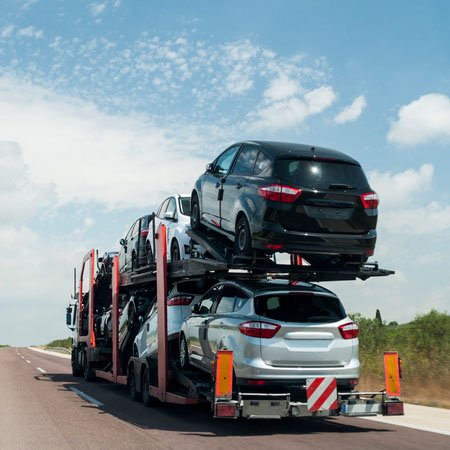
California is one of the busiest car shipping markets in the country, with heavy traffic on I-5, I-10, I-15 and I-40. That volume helps keep prices competitive on major routes. Your price depends on:
- Distance and corridor: Routes from Texas, Arizona and the Pacific Northwest are short and busy. Routes from the Northeast and Florida are longer but well traveled.
- Vehicle size: Larger and heavier vehicles take more space and weight on a carrier.
- Transport type: Open car transport is standard. Enclosed car transport costs more and is popular for luxury and classic cars heading to Southern California.
- Season: Summer is peak season. Winter weather on mountain routes can slow transit and raise prices.
- Pickup and delivery location: Metro areas such as Los Angeles, the Bay Area, San Diego and Sacramento are easy to serve. Remote mountain and desert towns may cost more.
Typical planning ranges
These are common industry ranges for an operable sedan on an open carrier, for planning only.
| Route | Approx. distance | Typical open-carrier range |
|---|---|---|
| Phoenix, AZ to Los Angeles, CA | 370 miles | $450–$750 |
| Seattle, WA to San Francisco, CA | 810 miles | $700–$1,100 |
| Dallas, TX to Los Angeles, CA | 1,435 miles | $850–$1,350 |
| Chicago, IL to San Diego, CA | 2,080 miles | $1,050–$1,600 |
| New York, NY to Los Angeles, CA | 2,790 miles | $1,200–$2,000 |
| Miami, FL to Los Angeles, CA | 2,730 miles | $1,200–$1,950 |
Your exact price depends on your addresses, vehicle and dates. Get a written quote on our California car transport page.
How long does it take to ship a car to California?
| From | Typical transit time after pickup |
|---|---|
| Arizona, Nevada, Oregon | 1–3 days |
| Texas, Colorado, Utah | 3–5 days |
| Midwest | 5–7 days |
| Southeast and Florida | 7–10 days |
| Northeast | 7–10 days |
Add a pickup window of one to five days before transit begins. Popular routes include Texas to California car shipping, New York to California car shipping and Florida to California car shipping.
Why transit times vary
Car carriers usually haul seven to ten vehicles at once, so your car shares the truck with other customers’ cars heading in the same general direction. The driver plans the route around every pickup and delivery on the load, which is why transit estimates are given as a range. Federal hours-of-service rules also limit how long a driver can drive each day. In winter, snow on I-80 over Donner Pass or on I-70 through the Rockies can force carriers to reroute south on I-40 or I-10, adding a day or two. During summer, heavy demand on routes into Southern California can lengthen the pickup window, so booking early matters most from May through August.
Door-to-door delivery in California cities
Most California deliveries are door to door, but some addresses are hard for an 80-foot carrier to reach. Hillside streets in the Hollywood Hills, Berkeley and San Francisco, gated communities in Orange County, and narrow beach-town streets in Santa Monica, Venice and Pacific Beach often require a nearby meeting point such as a shopping center parking lot. Tell us about steep driveways, low branches, HOA rules or permit-only parking when you book, and the driver will call ahead to agree on the easiest safe spot.
How to prepare your car for transport
- Fix the check engine light. You will need a smog check soon after you arrive, and a warning light is an automatic fail.
- Wash the car and take photos of every side, the wheels, the interior and the odometer.
- Remove personal items, toll transponders and parking permits. Personal items are not covered by carrier insurance.
- Leave a quarter tank of fuel or less.
- Disable the alarm, or explain to the driver how to turn it off.
- Remove loose accessories such as bike racks and roof boxes.
- Note low clearance or modifications when you book, so the right carrier is assigned.
Registering your car with the California DMV
According to the California DMV, new residents must register their vehicles within 20 days of establishing residency. Residency begins when you take a job, rent or buy a home, enroll your children in school or do anything else that shows you intend to live in California. Most people register at a DMV field office. Booking an appointment online saves a lot of waiting.
What to bring
- Application for Title or Registration (REG 343), signed by every owner who will be on the California title.
- Your out-of-state title. If a lender holds it, bring your most recent out-of-state registration and the lender’s name and address. The DMV can request the title from the lender.
- Your most recent out-of-state registration card.
- A California smog certification, if your vehicle needs one (see below).
- Proof of California insurance.
- An odometer disclosure for vehicles less than ten years old.
- Payment for registration fees, the vehicle license fee and any use tax.
VIN verification
California requires a physical check of the vehicle identification number for out-of-state vehicles. You can have it done at a DMV office; the DMV offers a VIN verification lane if that is the only service you need. Peace officers and licensed vehicle verifiers can also perform it. Vehicles with salvage or other branded titles need an appointment with the California Highway Patrol instead.
The California smog check
Most out-of-state gasoline vehicles need a California smog check before they can be registered here. Smog tests from other states are not accepted. Tests are done at state-licensed Smog Check stations, and the results go to the DMV electronically.
Who needs a smog check?
- Most gasoline, hybrid and alternative-fuel vehicles from model year 1976 and newer
- Diesel vehicles from model year 1998 and newer with a gross vehicle weight rating of 14,000 pounds or less
Who does not?
- Fully electric vehicles
- Gasoline vehicles from model year 1975 and older
- Motorcycles
Some newer vehicles that are already registered in California can skip biennial smog checks for their first several years. For a car coming from another state, plan on getting a smog check during registration unless the DMV tells you otherwise.
Tips for passing on the first try
- Clear any check engine light and drive the car for a few days afterward, so its onboard monitors are ready.
- Drive for at least 20 minutes before the test, so the engine is fully warm.
- Make sure aftermarket parts such as intakes and exhausts carry a California Air Resources Board executive order number.
- Do not disconnect the battery right before the test; it resets the readiness monitors.
California registration fees and use tax
California registration can cost more than in many other states, because the fee includes several parts:
- Registration fee, a flat base fee
- Vehicle license fee (VLF), based on the car’s value, roughly 0.65% of the current market value
- Transportation improvement fee, tiered by vehicle value
- County and district fees, which vary by where you live
- Title fee for the new California title
Do you owe use tax?
California charges use tax, at the same rate as local sales tax, on vehicles brought into the state within a set period after purchase. If you bought the car recently and used it mainly outside California, you may still owe tax unless you can show you paid sales tax in another state, which is usually credited against it. If you owned and drove the car out of state for a long time before moving, use tax generally does not apply. Bring your purchase paperwork in case the DMV asks.
California car insurance requirements
California raised its minimum liability limits on January 1, 2025. Every registered car now needs at least:
- $30,000 for injury or death of one person
- $60,000 for injury or death of more than one person
- $15,000 for property damage
These are only minimums. With repair costs and medical bills in California’s big metros, many drivers carry far higher limits, plus uninsured motorist and collision coverage. Start your California policy on the day you move, and keep your old policy until the new one is active.
Getting a California driver license
New residents should apply for a California driver license within 10 days of moving. You will need to show proof of identity, your Social Security number and two documents proving California residency, and pass a vision test. Depending on your situation, you may also need to take a knowledge test. Ask for a REAL ID when you apply.
Will your car pass California rules?
Before you ship, check for issues that can make registration harder:
- Emissions label: Look under the hood for a label that says the car conforms to California regulations, or says it is “50-state” or “California certified.” Some cars built only for federal standards cannot be registered in California unless they are older or have enough miles.
- Window tint: California limits front-side window tint. Dark tint from another state can lead to a fix-it ticket.
- Lift kits and exhausts: Loud exhausts and some suspension changes can lead to tickets or failed smog.
- Front license plate: California requires front and rear plates on most passenger vehicles. If your car came from a state that uses only a rear plate, you may need a front bracket.
Life with a car in California’s major regions
Los Angeles and Orange County
Car ownership is almost a requirement. Plan for traffic on the 405, the 101 and the 10, permit parking in many neighborhoods and street-sweeping days that move cars off certain blocks. See our Los Angeles car shipping page if you are moving here.
The San Francisco Bay Area
San Francisco has good transit and expensive parking; many residents get by with one car or none. The South Bay, the East Bay and the Peninsula are more car-dependent. Watch for bridge tolls and, in San Francisco, curb colors and steep-hill parking rules. See our San Francisco car shipping page.
San Diego
San Diego is spread out and car-friendly, with a large military community that ships vehicles in and out often. Our San Diego car shipping page and military car shipping service cover PCS moves.
Sacramento, the Central Valley and the Inland Empire
These regions are fast-growing and highly car-dependent. Summer heat is intense, so check your car’s cooling system, battery and tires before your first summer.
If you are going on to Hawaii
Many people moving to Hawaii ship their car from a California port. See our guide to California to Hawaii car shipping.
Moving an electric vehicle to California
California has more electric vehicles than any other state, and moving one here is straightforward. Fully electric cars do not need a smog check, so registration is usually faster. A few tips:
- Charge level for shipping: Carriers generally ask for an EV to arrive at pickup with roughly 30% to 50% charge, enough to load, unload and reach a charger, without adding unnecessary weight to a fully charged battery.
- Home charging: If you are renting, ask your landlord about Level 2 charging before you move. Many California apartment buildings now offer shared chargers.
- Public charging: California has one of the densest public charging networks in the country, especially along I-5, US-101 and I-15.
- Carpool lanes: Rules for clean-air vehicle access to carpool (HOV) lanes have changed over time. Check the current status with the DMV before counting on solo HOV access.
- Heavier vehicles: EVs are heavy. Tell us the exact model when you book so the carrier can plan the load correctly.
Bringing a classic, exotic or modified car
Southern California is famous for car culture, and many people move collector cars here. For classics, exotics and lowered cars, enclosed car transport protects the paint from road debris and weather and keeps the car out of sight during the trip. Ask for a carrier with a liftgate if the car has low ground clearance. If the car has an aftermarket exhaust, intake or engine swap, check before you move whether the parts carry a California Air Resources Board executive order number, because parts without one can cause a failed smog check. Cars from model year 1975 and earlier are exempt from smog, which makes California a good home for vintage vehicles.
Common mistakes to avoid
- Shipping a car that cannot pass smog. Check the emissions label and fix the check engine light first.
- Missing the 20-day registration window. Late registration brings penalties, and they grow over time.
- Forgetting about use tax on a recently purchased car.
- Leaving personal items in the car during transport.
- Booking during peak season without notice. Book four to six weeks ahead for summer moves.
- Not getting the price locked in writing. Ask whether your quote can change after you book.
How NIKI Auto Transport helps
NIKI Auto Transport is a licensed and bonded auto transport broker (USDOT 4535689, MC-1799148). We connect you with vetted, insured carriers on every major route into California and give you a written price backed by NIKI’s Price Guarantee. Choose open or enclosed transport, door-to-door service, and updates from pickup to delivery.
Start with a free quote on our California car shipping and car transport services page, or call (818) 732-1805.
Frequently asked questions
How long do I have to register my car in California after moving?
New residents must register their vehicles within 20 days of establishing California residency.
Does my car need a smog check to register in California?
Most gasoline vehicles from 1976 and newer and many diesel vehicles from 1998 and newer need a California smog check. Electric vehicles do not. Smog tests from other states are not accepted.
Do I have to pay use tax when I move my car to California?
Possibly, if you bought the car recently. Sales tax you paid in another state is generally credited. If you owned and used the car out of state long before moving, use tax usually does not apply.
What is the minimum car insurance in California?
Since January 1, 2025, the minimums are $30,000 per person, $60,000 per accident for bodily injury and $15,000 for property damage.
How long does it take to ship a car to California?
One to three days from neighboring states, three to five days from Texas, and about seven to ten days from the East Coast, after a pickup window of one to five days.
Is it cheaper to ship or drive a car to California?
For cross-country moves, shipping usually costs about the same as driving once you count fuel, hotels, food and time off work, and it saves nearly a week.
Requirements and fees change. This guide reflects California DMV guidance as of 2026; confirm current rules at dmv.ca.gov before you apply.